
For the average nursing student, entering the world of pharmacology feels like being dropped into a foreign country without a map. Suddenly, you are expected to become fluent in a complex medical language made up of words like metoprolol, atorvastatin, and furosemide. You aren’t just memorising a list of names; you have to understand how these chemical compounds interact with the human body, their potential side effects, and how they save lives on the hospital ward. Trying to brute-force your way through hundreds of individual medications using traditional flashcards is a quick recipe for burnout.
The secret to mastering this massive volume of medical information isn’t studying harder; it is studying smarter by organizing medications into distinct families. When you learn how to look at the patterns behind the names, the chaos transforms into a logical system. Balancing these intense study demands alongside your clinical placement rotations and essay deadlines can feel completely overwhelming. If the pressure of managing your heavy university coursework begins to impact your study time, securing professional nursing assignment help directly from myassignmenthelp can give you the breathing room needed to focus entirely on mastering your practical medical concepts.
The Strategic Blueprint for Pharmacology Success
To conquer pharmacology without losing your peace of mind, you must move away from alphabetical lists. Instead, your study routine should focus on categorical organization, visual connections, and structural patterns.
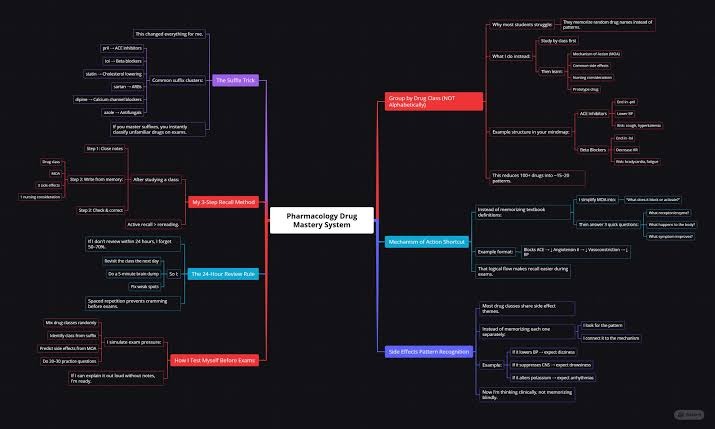
The Pharmacology Drug Mastery Framework. Source: Reddit
As illustrated in the study framework above, successful retention relies on breaking down broad categories into specific chemical identifiers, practical clinical red flags, and systematic tracking rules. Let us explore how to apply this structured method to your daily study routine.
1. Decode the Secret Code of Drug Suffixes
The absolute fastest way to group medications without losing your mind is to learn their suffixes—the word endings. The pharmaceutical world uses a highly structured naming convention regulated by international standards. Once you know what a specific ending means, you instantly know the drug class, how it works, and what condition it treats, even if you have never seen that exact medication before.
Think of suffixes as a family surname. For example, any medication that ends in -olol belongs to a family called Beta-Blockers. These medications work by slowing down the heart rate and reducing blood pressure. When you see atenolol, metoprolol, or propranolol, you do not need to panic. You already know exactly what they do because of that tiny four-letter ending.
Common Suffix Patterns to Memorise
- -pril: ACE Inhibitors (used for high blood pressure, e.g., lisinopril, enalapril)
- -sartan: Angiotensin II Receptor Blockers (also for blood pressure, e.g., losartan, valsartan)
- -prazole: Proton Pump Inhibitors (used to reduce stomach acid, e.g., omeprazole, pantoprazole)
- -statin: HMG-CoA Reductase Inhibitors (used to lower cholesterol, e.g., atorvastatin, simvastatin)
- -dipine: Calcium Channel Blockers (used for hypertension and angina, e.g., amlodipine, nifedipine)
- -afil: Phosphodiesterase inhibitors (used for erectile dysfunction or pulmonary hypertension, e.g., sildenafil)
By focusing your energy on memorising roughly twenty core suffixes instead of trying to learn two hundred individual drug names, you drastically reduce the cognitive load on your brain. It changes your study sessions from a painful exercise in memorisation into a simple game of word matching.
2. Group Medications by Their Mechanisms of Action
Once you can identify a medication by its suffix, the next step is to understand its mechanism of action—which is simply the scientific way of saying “how the drug does its job inside the body.” Instead of memorising a long paragraph of text for every single pill, try to visualize the biological doorway the drug interacts with.
Medications generally work in one of two ways: they either turn something on, or they turn something off. An agonist is a medication that binds to a cell receptor and activates it, causing a specific reaction. An antagonist acts like a biological shield, blocking the receptor so that other chemicals in the body cannot trigger it.
Create Visual Action Maps
Instead of writing out long sentences in your notebook, draw simple block diagrams that show cause and effect. If you are studying loop diuretics like furosemide, draw a simple picture of a kidney fluid pipeline. Show how the medication blocks sodium reabsorption, which forces water out of the body, ultimately lowering blood pressure.
When you anchor a drug name to a visual physiological process, your brain stores that information in its long-term memory. During a high-stress exam, your mind will find it much easier to recall a simple diagram you drew over a block of text from a dense reference manual.
3. Map Out Severe Adverse Effects, Not Every Single Side Effect
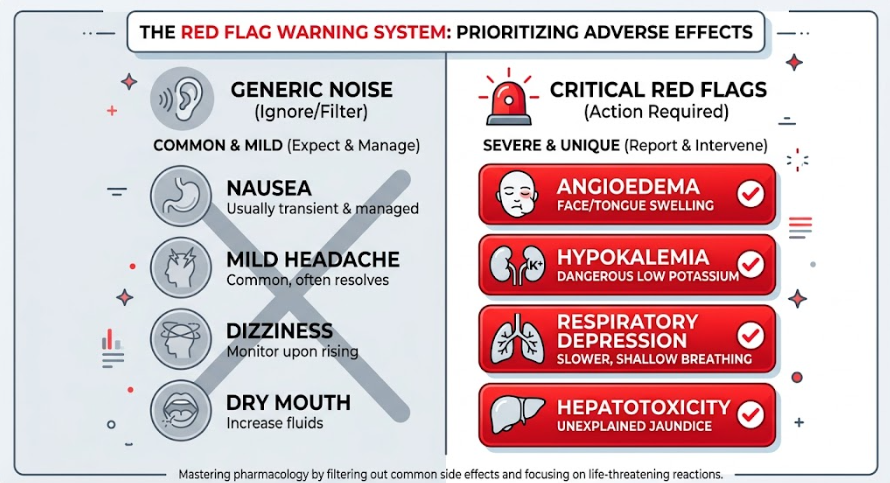
If you open any standard medical textbook, you will notice that almost every single medication listed includes nausea, headaches, dizziness, and a dry mouth as potential side effects. If you try to write down all of these generic symptoms for every drug class, your flashcards will all look identical, and you will learn absolutely nothing.
To study effectively, you need to filter out the noise and focus exclusively on the unique, severe, or life-threatening adverse effects associated with a specific drug class. These are the critical clinical details that examiners love to test you on, and they are the warnings you must know to keep your future patients safe on the ward.
Spot the Unique Clinical Red Flags
Every major drug family has a hallmark warning sign that defines it. For instance, ACE Inhibitors are famous for causing a persistent, dry hacking cough, as well as a rare but dangerous swelling condition known as angioedema. When you study potassium-wasting diuretics, your primary focus should be on the risk of hypokalemia (dangerously low potassium levels), which can cause serious heart rhythm issues.
When you sit down to study a class of medication, ask yourself one vital question: What is the single most dangerous thing this drug could do to my patient? Write that one symptom down in bold red ink. Ignore the generic side effects like mild stomach upsets, and focus entirely on the clinical red flags.
4. Build Creative Memory Palaces and Mnemonics
The human brain is naturally terrible at remembering abstract chemical names, but it is incredibly good at remembering stories, locations, and strange associations. If you are struggling to make a specific medication stick in your mind, it is time to use creative mnemonics or build a memory palace.
A memory palace involves taking a physical space you know perfectly, like your childhood home, and mentally placing strange objects inside it to represent the things you need to remember. The stranger and more ridiculous the mental image is, the easier it will be for your brain to recall it later.
Turn Dry Data into Memorable Stories
Let’s look at the side effects of corticosteroids, which are often summarized by the mnemonic CUSHING:
- C – Cataracts
- U – Ulcers
- S – Skin thinning
- H – Hypertension (High blood pressure)
- I – Infections
- N – Necrosis of the bone
- G – Glycosuria (Glucose in the urine)
Instead of just staring at this list, imagine walking into your kitchen and seeing a massive, round cushion sitting on your stove, covered in sugar (representing high glucose) and wearing a pair of thick glasses (representing cataracts). This mental picture takes less than ten seconds to create, but the vivid visual narrative makes it nearly impossible to forget during an exam.
University life moves incredibly fast, and when multiple major modules require simultaneous submissions, finding the hours needed to build these elaborate memory tools becomes difficult. During these chaotic weeks, finding affordable options for academic support like cheap assignment help can help you manage your writing schedule effectively, ensuring you don’t fall behind while dedicating your weekends to exam preparation.
5. Use the Spaced Repetition Method for Long-Term Recall
Reviewing your pharmacology notes the night before an exam is a guaranteed path to failure. The human mind operates on a “use it or lose it” principle known as the forgetting curve. When you learn new information, your brain discards it within twenty-four hours unless you actively review it.
To move drug classes from your short-term memory into your long-term memory, you must use spaced repetition. This means reviewing your study material at gradually increasing time intervals—such as one day after learning it, then three days later, then a week later, and finally a month later.
Day 1: Initial Learning ──> Day 2: First Review ──> Day 5: Second Review ──> Day 12: Third Review
Put Your Knowledge into Practice
Don’t just read over your notes during these review sessions. Force your brain to actively work through flashcard apps, take practice quizzes, or explain a drug class aloud to a classmate as if they have never heard of it before. Teaching a concept to someone else is the ultimate test of your own understanding. If you can explain how a medication works in simple terms without looking at your book, you have truly mastered the material.
6. Real-World Application: The Prototype Drug Strategy
When you are faced with a massive drug class containing dozens of variations, do not try to study every single one with equal intensity. Instead, use the Prototype Drug Strategy. A prototype drug is an individual agent that perfectly represents the characteristics of its entire class.
For example, when studying opioid analgesics, focus almost all your primary study energy on Morphine. Understand its therapeutic targets, its absorption patterns, its severe respiratory depression risks, and its reversal agent (Naloxone). Once you know Morphine inside out, you automatically understand ninety percent of how codeine, fentanyl, and oxycodone work, because they simply follow the path of their prototype leader.
Also Read: Inside the World of Sicilian Women: History, Culture, and Society
Comprehensive Summary Table of Essential Drug Classes
To give you an immediate head start on your study tracking, use this master reference table to organize your primary review priorities across major cardiovascular, renal, and gastrointestinal medications.
| Drug Class | Common Suffix | Primary Clinical Indication | Key Patient Safety & Assessment Checks |
| Beta-Blockers | -olol | Hypertension, Arrhythmia, Heart Failure | Always check apical heart rate before administration; withhold the medication if the pulse is under 60 beats per minute. |
| ACE Inhibitors | -pril | Hypertension, Post-Myocardial Infarction | Monitor for a persistent dry cough. Watch closely for signs of angioedema (facial and airway swelling). |
| Statins | -statin | Hypercholesterolaemia, Cardiovascular Protection | Monitor liver function tests (LFTs) regularly. Instruct the patient to report any unexplained muscle pain or weakness immediately. |
| Proton Pump Inhibitors | -prazole | Gout, Gastric Acid Reflux, Peptic Ulcers | Encourage long-term bone density checks due to reduced calcium absorption risks over extended periods. |
| Loop Diuretics | -semide / -tanide | Fluid Overload, Chronic Oedema, Heart Failure | Monitor serum potassium levels closely to prevent hypokalemia. Document accurate fluid input and output sheets. |
| Calcium Channel Blockers | -dipine | Hypertension, Chronic Stable Angina | Avoid grapefruit juice as it increases drug concentration. Monitor the patient for peripheral edema in the lower limbs. |
Learning pharmacology does not have to mean losing your peace of mind. By shifting your focus toward universal suffixes, mapping out biological mechanisms, prioritizing critical red flags, and using smart memory techniques, you can confidently navigate your examinations and lay a solid foundation for a safe, successful medical career.
Frequently Asked Questions
What is the fastest way to group medications?
The most efficient method is categorization by common word endings or suffixes. Naming rules are standardized, so a drug’s suffix immediately reveals its functional medical family and primary therapeutic purpose.
How can I remember drug side effects without getting confused?
Filter out generic symptoms like nausea or headaches that apply to almost everything. Focus your study tracking exclusively on the unique, life-threatening clinical red flags linked to each specific drug family.
What is a prototype drug in pharmacology?
A prototype drug is a primary, well-studied agent that perfectly represents an entire medication class. Mastering this single representative drug helps you understand how other variations in that same family function.
How does spaced repetition help with exam preparation?
Instead of cramming, review your study material at expanding intervals—such as after one day, three days, and one week. This systematic review structure signals your brain to move complex data into long-term memory.
About The Author
Ella Thompson is a senior academic strategist and digital editor at myassignmenthelp, where she specializes in developing high-performance study frameworks and educational resources for higher education students. With a background in curriculum design and student mentorship, she creates practical content designed to simplify complex research structures and help students navigate the rigorous demands of university life.
