
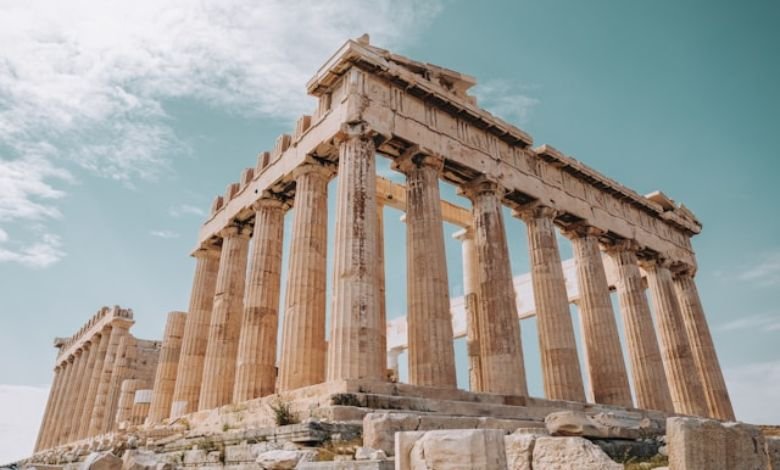
The Acropolis of Athens is an ancient citadel and religious complex situated on a rocky hill above Athens, Greece. Its surviving monuments represent some of the most influential achievements of Classical Greek architecture.
Although the Parthenon is its best-known building, the Acropolis also includes the Propylaea, the Erechtheion, and the Temple of Athena Nike. UNESCO describes the site as the most complete surviving monumental complex of ancient Greece and inscribed it on the World Heritage List in 1987.
Also Read: Sikkim Himalayas: History, Geography, Culture, and Key Facts
Acropolis of Athens Profile Summary
| Field | Details |
|---|---|
| Official name | Acropolis of Athens |
| UNESCO name | Acropolis, Athens |
| Location | Athens, Attica, Greece |
| Site type | Ancient citadel, sanctuary, and archaeological complex |
| Hill height | Approximately 156 metres |
| Principal historical period | Classical Greece |
| Main building phase | Fifth century BCE |
| Patron deity | Athena |
| Best-known monument | Parthenon |
| Other major monuments | Propylaea, Erechtheion, and Temple of Athena Nike |
| Key historical figure | Pericles |
| Major architects and artists | Iktinos, Kallikrates, Mnesikles, and Pheidias |
| UNESCO inscription | 1987 |
| UNESCO criteria | Cultural criteria i, ii, iii, iv, and vi |
Early History of the Acropolis of Athens
The history of the Acropolis extends far beyond the construction of the Parthenon. Its elevated position made it suitable for settlement, defense, government, and religious worship.
During the 13th century BCE, the hill served as a fortified Mycenaean citadel. Strong walls protected the residence of a local ruler and the surrounding administrative center.
The function of the hill gradually changed as political authority moved elsewhere in Athens. By the eighth and seventh centuries BCE, the summit had become a sacred area associated primarily with Athena, the patron goddess of the city.
Early temples were constructed for Athena Polias and other cults connected with Athenian tradition. Offerings, statues, altars, and ceremonial objects accumulated as the sanctuary developed during the Archaic period.
Persian Destruction and the Periclean Building Program
Persian forces captured Athens and destroyed much of the Acropolis sanctuary in 480 BCE. Temples and sculptures were damaged or burned during the invasion.
The present architectural character of the Acropolis largely resulted from a building program initiated several decades later. Under the leadership of the statesman Pericles, the Athenians commissioned new temples and ceremonial structures during the second half of the fifth century BCE.
This program brought together prominent architects and artists, including Iktinos, Kallikrates, Mnesikles, and Pheidias. The Parthenon was constructed between 447 and 438 BCE, with its sculptural decoration completed by approximately 432 BCE.
The Propylaea followed between 437 and 432 BCE. The Temple of Athena Nike and the Erechtheion were built later in the century. Together, these buildings established the monumental layout most closely associated with the Acropolis today.
Acropolis of Athens Architecture
The architecture of the Acropolis responds directly to the shape of its rocky setting. The summit is steep on most sides, while the principal approach is located on the west.
Rather than following a single symmetrical plan, the buildings occupy positions determined by terrain, religious traditions, earlier structures, and ceremonial routes. Visitors entering through the Propylaea encountered a carefully arranged group of temples, statues, and sacred spaces.
The monuments combine the two principal architectural orders used in Classical Athens. The Parthenon is predominantly Doric but incorporates important Ionic features. The Erechtheion and Temple of Athena Nike belong to the Ionic order.
Pentelic marble was the main material used in the Classical buildings. Quarried northeast of Athens, the stone was valued for its fine grain and light color.
Greek architects also employed subtle refinements rather than relying on perfectly straight lines. These included slight curves in horizontal surfaces, carefully adjusted column spacing, and entasis—a gentle outward curve in the profile of a column.
The Parthenon at the Acropolis of Athens
The Parthenon dominates the central area of the Acropolis. It was dedicated to Athena Parthenos, an aspect of the goddess Athena associated with the city.
Architects Iktinos and Kallikrates designed the temple, while Pheidias supervised its sculptural program. Construction began in 447 BCE. The main structure was completed in 438 BCE, and work on the sculptures continued until around 432 BCE.
The Parthenon is a Doric peripteral temple with eight columns across each end and seventeen along each side. Its design also incorporates Ionic elements, most notably the continuous sculpted frieze around the exterior of the inner structure.
Inside the eastern chamber stood a monumental gold-and-ivory statue of Athena created under the direction of Pheidias. The original statue has not survived.
The temple’s sculptural decoration formed a coordinated visual program. The east pediment represented the birth of Athena, while the west pediment showed the contest between Athena and Poseidon for control of Attica.
The metopes depicted legendary conflicts, including battles involving gods, giants, Amazons, centaurs, and figures associated with the Trojan War. The Ionic frieze presented a ceremonial procession generally connected with the Panathenaic festival.
The Parthenon’s proportions, sculptural program, and architectural refinements influenced later Greek, Roman, and Neoclassical design.
Major Monuments of the Acropolis of Athens
Propylaea
The Propylaea formed the monumental western entrance to the Acropolis sanctuary. Mnesikles designed the gateway as part of the Periclean building program.
Construction took place between 437 and 432 BCE. Work stopped around the beginning of the Peloponnesian War, leaving parts of the original design unfinished.
The building consists of a central entrance structure with adjoining wings. Its design addressed the uneven terrain while controlling movement into the sacred area.
Erechtheion
The Erechtheion was built between 421 and 406 BCE on the northern side of the Acropolis. Its complex and asymmetrical plan accommodated several religious traditions and sacred locations.
The temple was associated with Athena Polias, Poseidon, Erechtheus, and other figures from Athenian religion and mythology. Its eastern section contained the ancient wooden cult image of Athena Polias.
The building’s most recognizable feature is the south porch, where six sculpted female figures known as Caryatids served as architectural supports. Their combination of structural and sculptural functions made the porch a major work of Ionic design.
Temple of Athena Nike
The Temple of Athena Nike stands on a bastion near the southwest edge of the Acropolis entrance. Designed by Kallikrates, it was constructed during the late fifth century BCE.
The small Ionic temple was dedicated to Athena in her role as a goddess of victory. Its prominent position connected the sanctuary’s religious meaning with the defense and military fortunes of Athens.
Religious Significance of the Acropolis of Athens
The Acropolis was primarily a sanctuary rather than a public political meeting place. Its monuments supported the worship of Athena in several forms, including Athena Polias, Athena Parthenos, and Athena Nike.
Athenian mythology connected the hill with the contest between Athena and Poseidon for patronage of the city. According to the tradition, Athena offered the olive tree, while Poseidon produced a saltwater spring.
The Panathenaic festival was among the most important religious events associated with the sanctuary. Its ceremonies honored Athena and included a procession to the Acropolis.
The Erechtheion preserved locations and cults connected with these traditions. The Parthenon expressed the city’s devotion to Athena through its architecture, sculpture, and monumental cult statue.
Cultural Importance of the Acropolis of Athens
The Classical building program belonged to a period when Athens was a major political and cultural power. Democracy, philosophy, drama, historical writing, sculpture, and architecture all developed significantly within the broader society of fifth-century Athens.
The Acropolis monuments became enduring models of proportion, visual balance, and architectural planning. Greek and Roman builders studied their forms, while later Neoclassical architects adapted elements of the Parthenon and Propylaea for government buildings, museums, universities, and memorials.
The complex therefore documents both ancient Athenian religion and the wider influence of Classical Greek design. Its importance is historical rather than dependent on any single surviving building.
Damage and Transformation of the Acropolis of Athens
The monuments underwent several changes after antiquity. The Parthenon suffered fire damage during the late Roman period and was later adapted for Christian worship.
During the Byzantine period, it functioned as a church. Under Latin rule, it became a Catholic place of worship. Following the Ottoman conquest of Athens, the building was converted into a mosque.
The most destructive event occurred in 1687 during a Venetian siege of the Acropolis. Ottoman forces were storing gunpowder inside the Parthenon when Venetian artillery struck the building. The resulting explosion destroyed much of the temple’s central structure.
During the early 19th century, agents working for Thomas Bruce, the seventh Earl of Elgin, removed a substantial group of Parthenon sculptures and architectural elements. Surviving sculptures from the Acropolis are now divided among the Acropolis Museum, the British Museum, and several other collections.
Restoration of the Acropolis of Athens
Restoration began after the establishment of the modern Greek state. During the 19th century, many Byzantine, Frankish, and Ottoman additions were removed as the site was reorganized as an archaeological monument.
Large restoration programs followed during the late 19th and early 20th centuries. Some early projects used iron reinforcements, cement, and combinations of fragments that were later found to cause structural problems.
In 1975, Greece established the Committee for the Conservation of the Acropolis Monuments. Modern work seeks to correct earlier interventions, stabilize damaged structures, conserve marble surfaces, and return identified architectural members to their documented positions.
Current restoration principles emphasize reversibility, detailed documentation, respect for original material, and limited intervention. New Pentelic marble is used when structurally necessary, while titanium rods and clamps replace corroding iron components.
The Acropolis Museum preserves many original sculptures and artifacts removed from outdoor exposure. Replicas have replaced vulnerable originals in certain locations, helping maintain the architectural form of the monuments while protecting ancient material.
Acropolis of Athens UNESCO World Heritage Status
UNESCO added the Acropolis of Athens to the World Heritage List in 1987 under cultural criteria i, ii, iii, iv, and vi.
The designation recognizes the site as a major artistic achievement, an influential architectural model, evidence of ancient Greek religion, an important historical ensemble, and a place closely connected with ideas that shaped Classical civilization.
UNESCO also identifies the relationship between the architecture and the natural hill as a central part of the site’s importance. The buildings were planned as an interconnected monumental landscape rather than as isolated structures.
Acropolis of Athens FAQs
What is the Acropolis of Athens?
The Acropolis of Athens is an ancient fortified hill and religious sanctuary above Athens. It contains the remains of several major Classical Greek monuments.
Is the Parthenon the same as the Acropolis?
No. The Acropolis is the entire archaeological complex, while the Parthenon is one temple located within it.
When was the Acropolis of Athens built?
The hill was occupied and fortified long before the Classical period. Most of its principal surviving monuments were constructed between 447 and 406 BCE.
Who built the Acropolis of Athens?
The complex developed over many centuries. Pericles directed the main fifth-century BCE building program, which involved architects and artists including Iktinos, Kallikrates, Mnesikles, and Pheidias.
What are the four principal Acropolis monuments?
The four principal Classical monuments are the Parthenon, the Propylaea, the Erechtheion, and the Temple of Athena Nike.
Conclusion: Acropolis of Athens History and Legacy
The Acropolis of Athens developed from a Mycenaean citadel into the leading religious sanctuary of ancient Athens. Its principal surviving monuments were constructed during the fifth century BCE under the building program associated with Pericles.
The Parthenon remains its most prominent structure, but the Propylaea, Erechtheion, and Temple of Athena Nike are equally important to understanding the complex. Together, they demonstrate the technical skill, religious traditions, and artistic priorities of Classical Athens.
Despite warfare, religious conversion, structural damage, and earlier restoration problems, the Acropolis has retained its historical and architectural importance. Its UNESCO status and continuing conservation program reflect its recognized place in the cultural heritage of Greece and the wider world.
